
Wholesale inflation fell to a 4-month low of 1.31 per cent in August due to a decline in prices of vegetables and fuel, even though onion and potato prices spiked, according to official data released on Tuesday. Wholesale price index-based inflation fell for the second straight month in August after it hit a high of 3.43 per cent in May. Inflation in July was 2.04 per cent. In August last year, WPI inflation was (-) 0.46 per cent.

The RBI has shelved its plan for polymer notes more than a decade after it invited interest from global manufacturers for one billion pieces of Rs 10 denomination polymer banknotes, reveals Tamal Bandyopadhyay.

Wholesale inflation in the country rose for the fourth consecutive month in June at 3.36 per cent on account of rise in prices of food articles, especially vegetables and manufactured items. The wholesale price index (WPI) based inflation was 2.61 per cent in May. It was (-) 4.18 per cent in June 2023.

RBI's fifth bi-monthly monetary policy meet due tomorrow also kept the investors on their toes.

Declining for the third consecutive week, India's forex reserves dipped by $77 million to reach $635.83 billion for the week ended December 10, RBI data showed on Friday. In the previous week, the reserves had slid by $1.78 billion to $635.90 billion. In the reporting week ended December 10, the dip in the forex kitty was on account of a decline in foreign currency assets (FCA), a major component of the overall reserves.
Historically, the RBI has tried to keep the crooks at bay by issuing a circular a day. What it needs is more onsite supervision. Merely checking high-frequency data with the help of technology is insufficient, notes Tamal Bandyopadhyay.

Reserve Bank Deputy Governor Michael Patra on Wednesday said the central bank's views about cryptocurrencies might have delayed the government's proposed legislation on crypto assets. Emphasising that the Central Bank Digital Currency (CBDC) will be introduced in FY23 as announced by Finance Minister Nirmala Sitharaman in the Budget speech, Patra said India will proceed very gradually on the subject as there are concerns on privacy, its impact on monetary policy formulation and energy intensity. The government had plans to introduce a bill on cryptocurrencies like Bitcoin during the Winter Session of Parliament in November-December 2021 but did not introduce it.

The number of cyberfraud cases has skyrocketed from 2,677 in 1999-2000 to 29,082 in FY24 -- more than a 10-fold increase. The RBI pegs digital payment frauds at Rs 1,457 crore in FY24, up more than five times in a year. It's not just the number of frauds. What's alarming is the growing sophistication of the fraudsters, exposing the vulnerabilities within the financial system, observes Tamal Bandyopadhyay.

Indians remitted close to $2 billion in November under the Reserve Bank of India's (RBI's) liberalised remittance scheme (LRS), latest data released by the central bank showed. Outward remittances under the scheme jumped 29 per cent to $1.99 billion compared to $1.54 billion in the year-ago month. Sequentially, outward remittances under the scheme were up about 3.5 per cent.

Recent RBI data indicates net addition of credit cards is running strong at 18 per cent year-on-year (Y-o-Y), but growth in credit card limits is ahead of loans outstanding. Growth in lower limit cards is decelerating fastest. The West and South have more usage and online transactions are more popular than offline, with metros leading growth.

Cracking down on repeated non-compliance of IT norms, the RBI on Wednesday barred Kotak Mahindra Bank from onboarding new customers through its online and mobile banking channels and issuing fresh credit cards with immediate effect after the regulator found "serious deficiencies" in the lender's IT risk management. These actions, the RBI said, are necessitated based on significant concerns arising out of Reserve Bank's IT examination of the bank for the years 2022 and 2023 and the continued failure on part of the bank to address these concerns in a comprehensive and timely manner.
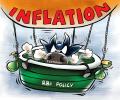
The Reserve Bank of India on Thursday marginally lowered its inflation projection for the current financial year to 5.1 per cent, as Governor Shaktikanta Das said the central bank's monetary policy actions are yielding the desired results. In April, the Reserve Bank had estimated the consumer price index (CPI) based retail inflation at 5.2 per cent during the fiscal 2023-24. CPI inflation fell sharply to 4.7 per cent in April 2023, from 6.4 per cent in February, on the back of favourable base effects, with softening observed across all the three major groups.

The Reserve Bank on Monday advised banks to provide shade from the sun and water to customers waiting to exchange or deposit Rs 2,000 notes. It can be noted that during the note ban in 2016, there were allegations of customers dying while waiting in queues to exchange bank notes. Following Friday's announcement of withdrawing Rs 2,000 notes -- the notes continue to be legal tender unlike demonetisation exercise -- there were concerns about customers facing inconvenience, especially given the summer being at its peak.

Credit card spending in September recorded strong growth of 25 per cent year-on-year (Y-o-Y), marking the highest increase in six months. Even as many banks saw higher slippages during the July-September quarter of 2024-25, spending growth exceeded 20 per cent for the first time since February. According to the latest data released by the Reserve Bank of India (RBI), September spending reached Rs 1.76 trillion, compared to Rs 1.42 trillion in the same period a year ago. In August 2024, credit card spending was Rs 1.68 trillion.

The wholesale inflation rose to a 13-month high of 1.26 per cent in April fuelled by rising prices of food articles, especially vegetables, amid expectations of RBI holding interest rates in the policy review next month. The wholesale price index (WPI) based inflation has been rising for two months in a row.

Quarterly earnings of corporates, trading activity of foreign investors and inflation data are the key factors that are expected to drive the momentum in the equity markets this week, analysts said.

Continuing their downward trajectory for the third consecutive week, the country's foreign exchange reserves declined by $2.03 billion to stand at $617.648 billion in the week ended March 25, RBI data showed on Friday. In the week ended March 18, the forex kitty had declined by $2.60 billion to $619.68 billion. It had plunged by $9.65 billion to $622.27 billion in the week ended March 11.

The country's foreign exchange reserves rose by $758 million to reach a record high of $586.082 billion in the week ended January 8, RBI data showed on Friday. In the previous week ended January 1, the reserves had increased by $4.483 billion to $585.324 billion.

India's current account deficit (CAD) may dip further in the March quarter of FY24 as pressure from the negative net exports during the January-March period eased to an 11-quarter high. A part of the gross domestic product (GDP) data, net export- which is usually negative for India - captures the difference between exports and imports of both goods and services, while the CAD data, released by the Reserve Bank of India (RBI), also factors in private transfer receipts.

India's foreign exchange reserves increased $2.95 billion to $645.58 billion for the week ended March 29, the Reserve Bank of India (RBI) said on Friday. This is the sixth consecutive week of a jump in overall reserves. The kitty had increased $140 million to $642.63 billion in the previous reporting week.

The RBI on Tuesday said state-owned SBI, along with private sector lenders ICICI Bank and HDFC Bank continue to be Domestic Systemically Important Banks (D-SIBs) or institutions which are 'too big to fail'. SIBs are perceived as banks that are 'too big to fail (TBTF)'. This perception of TBTF creates an expectation of government support for these banks in times of distress. Due to this perception, these lenders enjoy certain advantages in the funding markets.

While Paytm (One97 Communications) is not completely past regulatory hurdles, its share price has gained in the last month or two. The Paytm handle migration is complete along with FDI clearance necessary for the Payment Aggregator (PA) license. UPI consumer data indicates stable market share, and expansion in partner networks in financial distribution. All this implies Paytm could be set to meet guidance of turning Adjusted Ebitda breakeven by Q4FY25 (ex of UPI-incentives).

Retail inflation eased to an 11-month low of 4.83 per cent in April as prices of some kitchen items declined though overall food basket firmed up marginally, according to a government data released on Monday. The Consumer Price Index (CPI)-based retail inflation was 4.85 per cent in March. It was 4.7 per cent in April 2023.

Domestic rating agency Icra on Wednesday said India's real GDP growth for the September quarter is likely to decline to 6.5 per cent due to heavy rains and weaker corporate performance. The agency, however, maintained its FY25 growth estimate at 7 per cent on expectations of a pick up in economic activity in the second half of the fiscal.
Wholesale inflation rate declined marginally to 0.2 per cent in February compared to 0.27 per cent in the preceding month despite a slight uptick in the food basket. The Wholesale Price Index (WPI)-based inflation was in the negative zone from April to October and had turned positive in November at 0.26 per cent. The inflation in February 2023 was 3.85 per cent.

'Whether I am optimistic or pessimistic is not the issue; I am just going by the evidence available.' 'The Indian economy and financial sector are now well-placed and very resilient in dealing with any kind of spillover coming from the external world.'
India's forex reserves jumped by $2.98 billion to a fresh peak of $648.56 billion for the week ended April 5, the RBI said on Friday. In the previous reporting week, the forex kitty had increased by $2.951 billion to $645.583 billion, which was an all-time high. In September 2021, the country's forex kitty reached an all-time high of $642.453 billion, a level that was breached in March this year.

The Congress on Thursday accused the Modi government of aiding 'drain of wealth' from ordinary Indians to crony corporates, and said it will end this practice if it comes to power at the Centre.

The foreign exchange kitty had crossed the half-a-trillion mark for the first time in the week ended June 5, 2020, after it had swelled by $8.223 billion to stand at $501.703 billion.

IT and interest rate-sensitive bank, realty, and auto stocks ended with sharp gains.

After subdued earnings in the first half amid global headwinds, India Inc is taking a cautious approach on their capital expenditure (capex) for the second half of the financial year ending March 2025, according to management commentary. Minutes from the October monetary policy meeting show the Reserve Bank of India's (RBI's) optimism about private investments picking up.
Retail inflation eased to a one-year low of 4.75 per cent in May as prices of some kitchen items declined marginally, according to government data released on Wednesday. The Consumer Price Index (CPI) based retail inflation was 4.83 per cent in April 2024 and 4.31 per cent in May 2023 (previous low).

In its latest monetary policy report released recently, RBI had said credit growth is likely to remain modest, reflecting weak demand and risk aversion due to the disruptions caused by the coronavirus pandemic.

In its scheme of things, tackling inflation now comes ahead of ensuring growth in the world's sixth largest economy, points out Tamal Bandyopadhyay.

India's forex reserves decreased $2.282 billion to $640.33 billion for the seven days ended April 19 in the second consecutive week of drop in the kitty, the Reserve Bank of India (RBI) said on Friday. The reserves had dropped $5.40 billion to $643.16 billion in the previous reporting week, ending a multi-week trend of an increase, which also saw the overall reserves touching a new all-time high of $$648.56 billion for the week ended April 5.

India's foreign exchange reserves declined for the second consecutive week, ending $1.78 billion down at $635.91 billion for the week ended December 3, RBI data showed on Friday. In the previous week, the reserves had slid by $2.71 million to $637.68 billion. In the reporting week ended December 3, the dip in the forex kitty was mainly on account of a decline in foreign currency assets (FCA), a major component of the overall reserves.

The country's foreign exchange reserves rose by $563 million to reach $590.028 billion in the week ended May 14, RBI data showed on Friday. The reserves had touched a lifetime high of $590.185 billion in the week ended January 29, 2021. In the previous week ended May 7, 2021, the reserves had increased by $1.444 billion to $589.465 billion.

Of the 2,562 customer complaints received between January 2020 and March 2021, a majority relate to illegal apps. At least two dozen suicide cases have been reported, perpetrated by the harassment by loan app operators, points out Tamal Bandyopadhyay.

Incidentally, the central bank's comments come within weeks of economists raising doubts about the first quarter GDP data, where the government admitted to floundering.

Adani Ports was the biggest loser in the Sensex pack, declining 1.37 per cent, followed by ITC, Bharti Airtel, NTPC, Maruti, Asian Paints, Sun Pharma, Power Grid, Hindustan Unilever and Larsen & Toubro. In contrast, Bajaj Finserv, Bajaj Finance, IndusInd Bank, Tata Steel, Axis Bank and Tech Mahindra were among the gainers.
